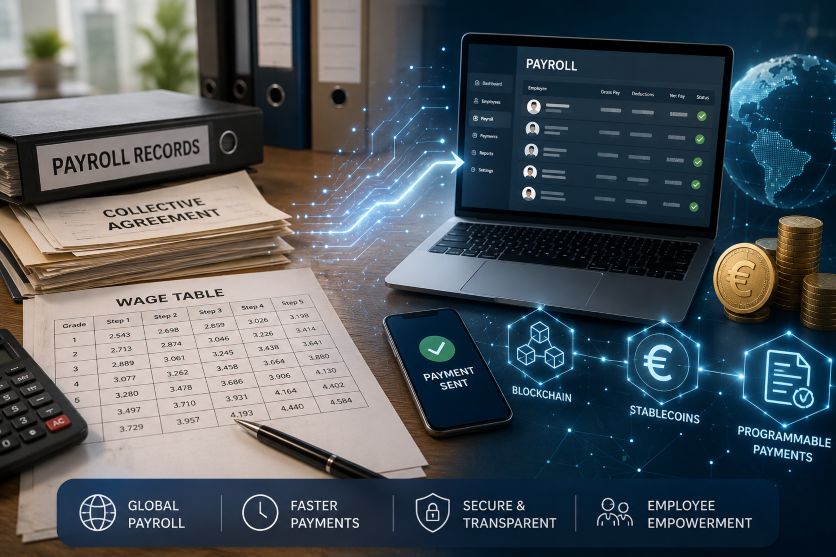
Payroll has changed greatly over the past century, but its basic purpose remains the same. Employers must calculate wages correctly and deliver them reliably. Standard wage structures, collective agreements, bank transfers, and payroll software have made that process more organized. Now, blockchain and programmable payment systems are raising a new question: could the way workers receive wages change again?
Germany provides a useful example of how structured pay works. Collective agreements and institutional wage tables can set out salary groups, experience levels, and other compensation rules in a form that workers can check. Resources such as the AVR Caritas Gehaltstabelle illustrate how established wage systems can make compensation easier to understand. This predictability matters because workers need to know what they earn and employers need clear rules for calculating pay.
Why Standardized Pay Still Matters
Technology may change how money moves, but it does not remove the need for clear wage rules. Collective agreements remain an important part of employment systems in many European countries. Data from the Organisation for Economic Co-operation and Development shows that collective bargaining continues to influence wages and working conditions across its member countries.
Traditional payroll also provides a clear record. Salary, taxes, deductions, overtime, bonuses, and benefits can be documented before money reaches an employee’s bank account. This structure supports transparency and makes errors easier to identify.
Digital payroll systems have already automated much of this work. The next stage may involve changing the payment infrastructure itself rather than simply improving payroll software.
What Changes When Wages Move Onto Digital Networks?
Blockchain systems can transfer digital assets between participants without relying on the same sequence of processes used by conventional banking networks. Tokenisation takes the idea further by representing money or other assets digitally on programmable platforms.
The Bank for International Settlements has studied how tokenisation could combine payment instructions, settlement, and related processes within shared systems. Its research suggests that this approach could reduce some transaction costs and make new payment arrangements possible. However, strong governance and risk controls would still be necessary.
This could matter for employers with workers in several countries. International payroll can involve different banks, currencies, processing times, and reconciliation tasks. A tokenised system could eventually reduce some of those steps.
Could Stablecoins Become Part of Payroll?
Stablecoins are digital assets designed to maintain their value against another asset, commonly a national currency. That makes them different from cryptocurrencies whose prices may move sharply within a short period.
The European Central Bank notes that stablecoins can offer features such as continuous availability and programmability. These qualities could make them useful for certain payment situations, especially transactions that cross national borders. However, the ECB also warns that stablecoins can carry credit and liquidity risks. Their reliability depends partly on reserves, redemption arrangements, and regulatory oversight.
For payroll, that creates both an opportunity and a problem. A worker could potentially receive a euro-linked digital asset quickly, even when living outside the employer’s home country. Yet employers would still have to consider labor law, taxes, reporting requirements, conversion costs, and whether workers can easily turn the asset into money they can spend.
Programmable Pay Could Go Beyond the Monthly Salary
One of the more interesting possibilities involves programmable payments. Instead of payroll systems simply sending a fixed amount on payday, payment instructions could respond automatically when agreed conditions are met.
A bonus, for example, might be released after a documented performance target is achieved. Contractors could receive payments when approved work stages are completed. Certain allowances could also be distributed according to predetermined rules. Similar forms of automation are appearing elsewhere in digital finance, including AI-powered investing and crypto automation, where technology can help manage transactions and financial decisions based on predefined goals or conditions.
Research from the Bank for International Settlements offers a larger-scale example. Project Agorá demonstrated a prototype where smart contracts could place workflow rules, compliance requirements, and payment conditions directly into transactions. The project focused on wholesale cross-border payments rather than employee payroll, but it shows how programmable financial infrastructure can automate conditions surrounding payments.
Where Digital Pay Still Faces Limits
Faster technology does not automatically create better payroll. Employers still need systems that protect workers, meet legal requirements, and provide dependable records.
Regulation is developing alongside the technology. The European Commission states that the EU’s Markets in Crypto-Assets Regulation, known as MiCA, provides a harmonised framework covering crypto-assets and related services that are not already governed by other EU financial legislation. The framework includes rules affecting stablecoin issuers and crypto-asset service providers.
There are practical concerns as well. Digital wallets can introduce security and access issues. Stablecoins may not always maintain their intended value perfectly. Employees may also prefer conventional bank deposits because rent, utilities, loans, and everyday purchases are still commonly settled in national currency.
The Bank for International Settlements has also cautioned that stablecoins currently fall short of some qualities needed to serve as the foundation of the monetary system. Its work instead points toward regulated tokenised central bank and commercial bank money as possible building blocks for future financial infrastructure.
The Future May Combine Old Rules With New Technology
Payroll is unlikely to abandon structured wage systems simply because new payment technology becomes available. The more realistic future may combine the two.
Collective agreements, salary tables, employment contracts, and labor laws could continue to determine what workers should receive. Digital networks could change how that money is processed and delivered. The European Central Bank is already exploring a European payment environment that includes tokenised deposits, regulated stablecoins, distributed ledger technology, and central bank settlement infrastructure.
That distinction is important. Technology can make payroll faster, more automated, and potentially easier to manage across borders. It cannot replace the principles that make wages dependable. Whatever form future salaries take, workers will still need transparency, predictable value, legal protection, and confidence that their pay will arrive when promised.